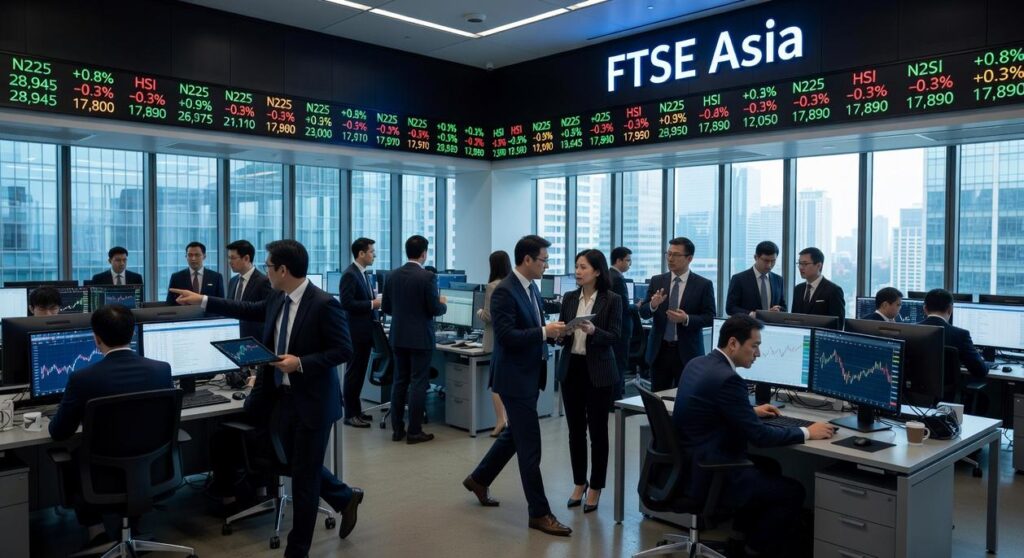

If you track Asian markets, chances are you’ve checked the FTSE Asia Index more times than you can count. But knowing the number isn’t the same as understanding how it’s built.
Many investors follow the index as a benchmark for regional performance, yet few truly grasp the mechanics behind its movements. Without understanding the ftse asia index calculation, it’s easy to misinterpret market swings, fund returns, or sector weightings.
You’re here to change that.
This guide breaks down the exact methodology behind the index—step by step. We’ll cover market-capitalization weighting, free-float adjustments, and the critical role of the index divisor. Using the official construction framework, we move beyond surface definitions to give you a clear, professional-level understanding of how the number is actually derived—and what it really means for your investment decisions.
Core Principles: Market Capitalization & Free-Float Adjustment
At the heart of most major indices is market-cap weighting—a method where a company’s influence is proportional to its total market value. Market capitalization simply means:
Share Price × Total Number of Issued Shares
So if Company A is worth $500 billion and Company B is worth $50 billion, Company A carries ten times more weight. Simple math, big implications.
Why Market-Cap Weighting Benefits You
This approach mirrors real-world market behavior. When larger companies move, they tend to move the broader market with them. By weighting companies according to size, the index reflects collective investor sentiment more accurately (S&P Dow Jones Indices explains this methodology clearly in its index framework).
Some critics argue this gives too much power to mega-cap firms. Fair point. If a handful of giants stumble, the index feels it. But here’s the upside: you’re tracking where the bulk of capital actually sits—not an artificial equal split that ignores economic reality. (It’s the difference between following the crowd at a stadium versus counting everyone equally from the parking lot.)
Introducing the Free-Float Factor
Now we refine things.
Free-float refers to the percentage of shares readily available for public trading. Shares held by:
- Governments
- Corporate insiders
- Other public companies
- Strategic, long-term holders
are excluded.
Why? Because you can’t realistically buy them.
The result is Investable Market Cap, calculated as:
Market Capitalization × Free-Float Percentage
This adjustment makes the ftse asia index calculation more practical and investable. You’re measuring what’s actually tradable—not theoretical ownership locked away in boardrooms.
What’s in it for you? A clearer picture of liquidity, risk exposure, and true market opportunity.
Pro tip: When comparing indices, always check whether they use full market cap or free-float adjustment—it can significantly change company weightings (MSCI methodology papers highlight this impact).
Constituent Selection and Index Maintenance

At first glance, an index can look like a static scoreboard. In reality, the FTSE Asia Index is more like a professional sports league—teams get promoted, relegated, and reshuffled based on performance.
Who Gets Included?
Inclusion starts with country of domicile (where a company is legally registered), along with primary listing location across major Asian exchanges such as the Tokyo Stock Exchange, Hong Kong Exchange (HKEX), and Singapore Exchange (SGX). Next comes market capitalization—the total value of a company’s outstanding shares—and liquidity, meaning how actively those shares trade.
These size and liquidity screens matter. A blue-chip like Samsung Electronics easily clears the bar, while a thinly traded small-cap from a frontier market likely won’t. The goal is to ensure constituents are both significant and investable (because no fund manager wants to move the market just by placing an order).
Size and Liquidity Screens
Minimum thresholds for market cap and trading turnover filter out illiquid names. This supports smoother tracking for ETFs and institutional funds that replicate the index. In markets like Indonesia or the Philippines, where liquidity can vary widely, these screens are especially critical.
Regular Rebalancing
However, the index isn’t frozen in time. It undergoes quarterly reviews to reflect shifts in corporate valuations and trading activity. During rebalancing, companies that fall below eligibility thresholds are removed, while newly qualified firms are added. Weights are recalculated using free-float adjusted market capitalization—a key input in ftse asia index calculation.
For a broader structural comparison, see ftse asia vs other regional indexes a comparative guide.
Some argue frequent reviews create volatility. Yet without them, the index would drift away from Asia’s evolving economic reality (and that would defeat the purpose entirely).
From Black Box to Clear Mechanism
You set out to understand how the ftse asia index calculation really works—and now you do.
What once felt like a mysterious market number is now a structured, rules-based system. You’ve seen how market-cap weighting forms the foundation, how free-float adjustments refine accuracy, and how the index divisor keeps everything consistent through corporate actions. The index is no longer abstract; it’s a logical reflection of the investable Asian stock market.
That clarity matters. It helps you evaluate index-tracking funds with sharper judgment, interpret market headlines with context, and approach futures trading with greater precision.
Next time you review your portfolio or scan Asian market news, apply this framework. If you’re serious about avoiding costly misreads and want reliable, data-driven insights trusted by active investors, start following our in-depth market updates today and stay ahead of the forces moving the index.